

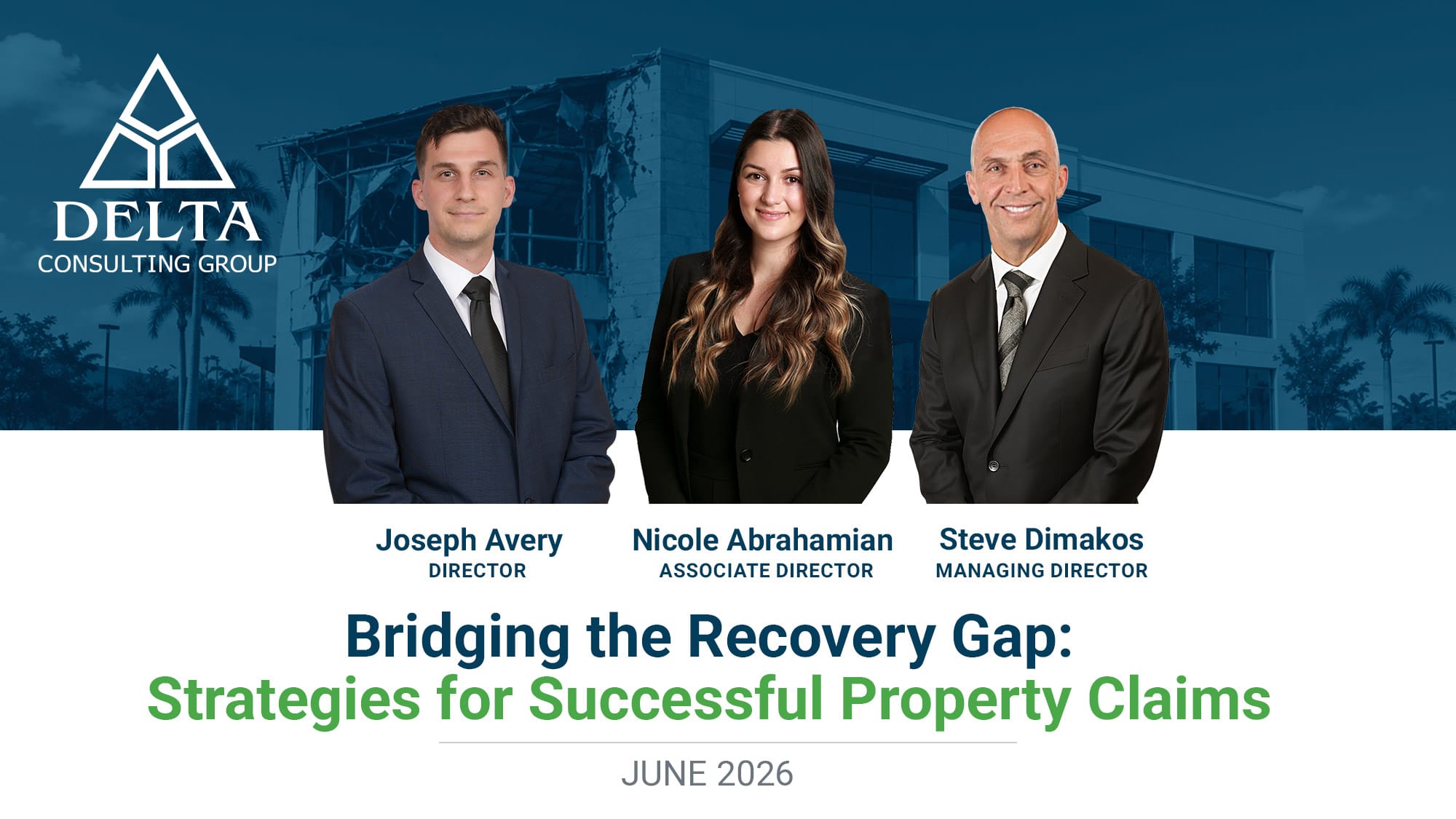
June 12, 2026 — by Associate Director Nicole Abrahamian, Director Joseph Avery and Managing Director Steve Dimakos at Delta Consulting Group
Property owners often assume that if a loss is covered, financial recovery will naturally follow. In practice, however, many policyholders discover that a covered claim does not always result in a recovery sufficient to restore the property or business to its pre-loss condition. Differences in policy interpretation, evolving scopes of damage, documentation challenges and overlooked claim elements can create a sizeable gap between expected and actual recovery.
Consider a luxury resort that sustained significant damage after a powerful hurricane made landfall. In the days following the storm, resort management acted quickly to stabilize the property, deploying internal resources and emergency response vendors to document visible damage and prevent further deterioration. Early discussions with the insurance carrier suggested the loss was covered and well within policy limits, leading the policyholder to expect a relatively straightforward claims process and financial recovery. As the claim progressed over the following months, however, the policyholder became increasingly frustrated that the property was not being restored to its pre-loss condition and that business interruption recoveries were insufficient to offset the resulting financial impacts.
Differences in the interpretation of policy provisions, disputes over the scope and valuation of damages, insufficient claim support and unrecognized claim-related expenses contributed to a growing disconnect between the policyholder’s claim and the insurer’s position. Although the claim was covered, the policyholder ultimately recovered less than was necessary to return the property to its pre-loss condition.
This scenario reflects a common challenge in property insurance claims: recovery shortfalls caused not by coverage denials, but by gaps in the claim adjustment process. Overlooked policy provisions, evolving scopes of work, inadequate support and unidentified recoverable expenses can significantly affect final recovery and demonstrate how even seemingly well-covered claims can become complex and contentious.
One of the most impactful challenges early in the claims process is defining the scope of loss. Property losses often continue to develop after the initial event, particularly following catastrophic incidents such as hurricanes or fires, resulting in a scope that evolves throughout the investigation. While this is a normal part of the process, an evolving scope can quickly become a moving target that complicates decision-making and alignment among stakeholders. As a result, the claims process can shift from proactive collaboration to retroactive debate.
Rather than agreeing on the required scope of work before repairs begin, parties may find themselves revisiting decisions after work is already underway. This can lead to delayed approvals, slower project execution, and interruptions in the cash flow needed to fund repairs. Establishing a well-defined scope and maintaining alignment among stakeholders throughout the process creates a stronger foundation for claim resolution and recovery.
Another common challenge involves distinguishing claim-related expenses from non-claim-related costs. This issue arises when emergency stabilization and restoration activities overlap with planned improvements, deferred maintenance or elective upgrades. Maintaining organized cost tracking and clearly identifying expenses incurred as a direct result of the loss can streamline the review process and accelerate recovery.
In addition, policyholders often select remediation strategies for legitimate operational or business reasons but may not fully explain why those choices are necessary or economically advantageous compared to alternative options. Demonstrating how a selected strategy reduces business interruption, minimizes operational disruption or lowers long-term costs can strengthen the claim and support recovery efforts. In many cases, a detailed cost-benefit analysis helps insurers better understand the rationale behind decisions and improves support for claimed costs.
Extra expense costs and operational impacts resulting from a loss are also frequently overlooked. Temporary barriers, fire watch services, emergency labor, and other protective measures may be necessary to maintain operations and prevent additional damage; yet these costs are not always identified as recoverable. For example, the resort may install decorative barriers to shield guests from active construction areas or retain around-the-clock fire watch personnel while life-safety systems are restored. Although these measures are implemented to sustain operations and reduce business disruption, they are direct consequences of the loss event. If associated costs are not properly identified, tracked, and documented, they may be excluded from the claim despite being legitimate recoverable expenses.
Ultimately, gaps in the claims process often result in an incomplete presentation of the loss, limiting how coverage is evaluated and applied. As property claims become increasingly complex and costly, these gaps can have a greater impact on financial recovery. A successful claim is rarely the result of coverage alone. Organizations that document losses thoroughly, define scope clearly, and identify all recoverable costs are best positioned to maximize recovery and realize the full value of their insurance coverage.
About the Authors:

Nicole Abrahamian specializes in the preparation, quantification, and resolution of complex property and business interruption insurance claims. Drawing on extensive experience in forensic insurance and claims recovery, she helps policyholders navigate major loss events and develop recovery strategies that align with policy coverage and operational objectives.

Joseph Avery has extensive experience helping organizations manage complex insurance claims and recovery programs. Drawing on a background in risk advisory, claims management, and forensic consulting, he works with commercial and public-sector clients to navigate major loss events and achieve defensible recovery outcomes.

Steve Dimakos brings decades of experience in property claims strategy, insurance policy interpretation, and disaster recovery consulting. He advises organizations on complex loss events, coverage matters, and recovery programs, helping clients achieve successful claim outcomes and accelerate recovery following catastrophic events.