

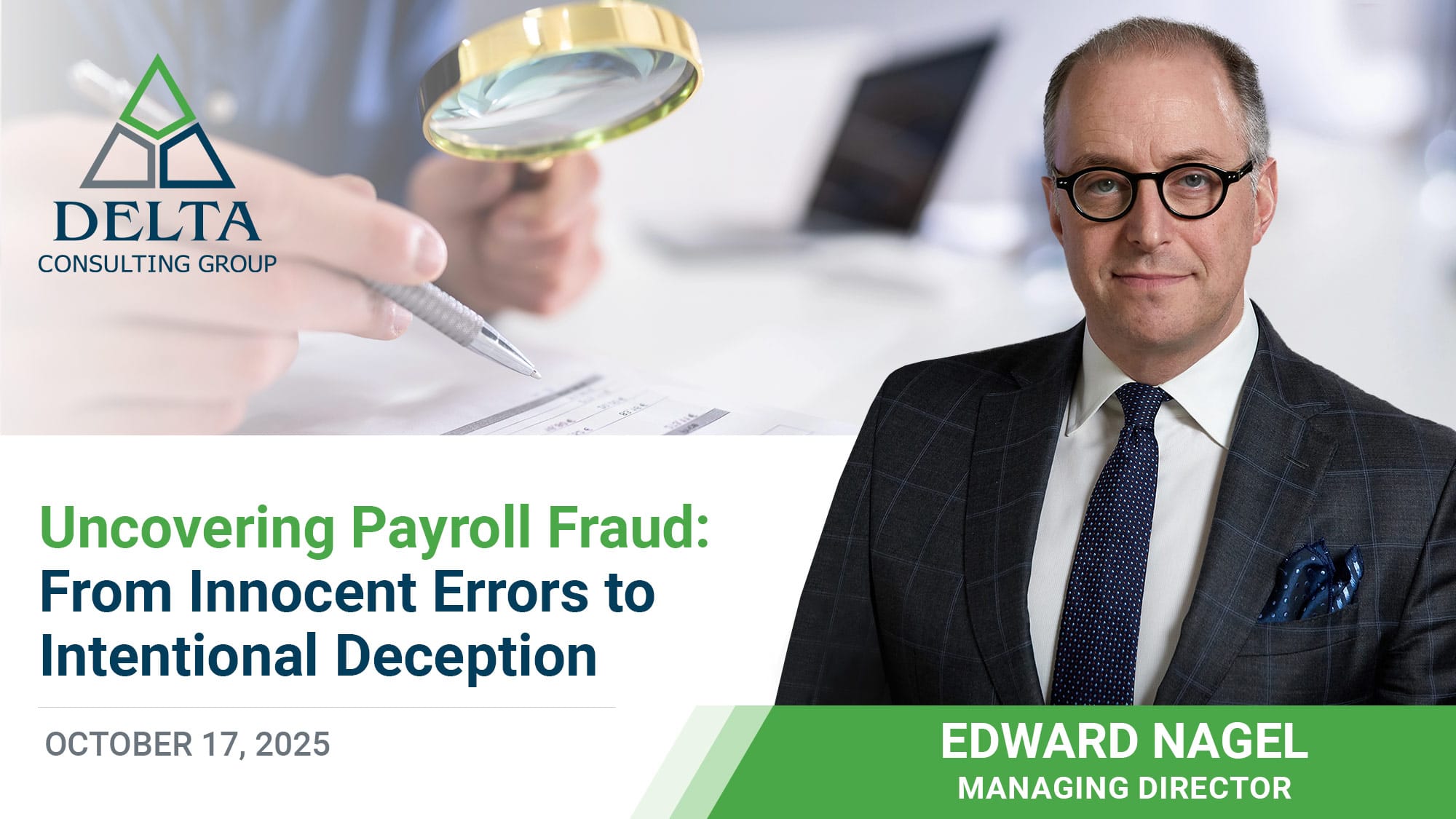
October 17, 2025 – by Edward Nagel, CPA, CA·IFA, CBV, CFF, Managing Director, Delta Consulting Group
Think payroll fraud is rare? Think again. The 2024 Report to the Nations from the Association of Certified Fraud Examiners (ACFE) shows that payroll fraud accounted for 10% of all occupational fraud cases, with a median loss of $50,000 per scheme. And payroll is just one example. Across all types of fraud, organizations are estimated to lose about 5% of their annual revenue, a staggering cost that highlights how widespread the problem really is.
Payroll fraud is often perpetrated not by career criminals, but rather by long-standing, trusted employees. These individuals are typically well-positioned within their organization, understand the systems they work within and know how to bypass or manipulate internal controls. Often, they don’t initially set out to defraud the company – fraud begins with an opportunity.
“Payroll fraud is often perpetrated not by career criminals, but rather by long-standing, trusted employees.”
In many instances, that opportunity starts with a simple mistake. A duplicate reimbursement, an incorrect pay rate amendment or a reactivated employee record might be processed without question. When the individual responsible notices the error wasn’t caught, they may try it again, this time deliberately. A one-time oversight becomes a testing ground and, eventually, a pattern. This transition from error to fraud is one of the most common and least discussed progressions in occupational misconduct.
In one real-world case, an employee failed to deduct a travel advance from their expense claim in a company where accounts payable handled the ‘advance’ and payroll handled the ‘reimbursement.’ When the overpayment went unnoticed, the employee began intentionally omitting deductions in future submissions.
In another case, a departing employee was accidentally paid twice, and the payroll clerk who processed the additional payment later reactivated that employee’s account, redirecting future payments to a bank account that they controlled. These schemes often unfold over months or years, gradually escalating as confidence in the system’s weaknesses grows.
Payroll fraud can take several forms, including:
- Ghost Employees: Creating fictitious individuals in the payroll system and diverting pay to the fraudster’s own account or an account that they control
- Falsified Wages: Manipulating hours worked or inflating hourly or salaried pay without proper authorization
- Unauthorized Benefits: Claiming benefits for ineligible employees or dependents
- Expense Reimbursement Fraud: Submitting duplicate, inflated or entirely fictitious claims
- Commission Schemes: Fabricating performance data or manipulating sales figures to trigger unearned bonuses or incentives
Red flags often emerge before the fraud is discovered. Employees who resist taking vacation, show signs of living beyond their means or exhibit sudden hostility toward colleagues or external auditors may be concealing misconduct. On the data side, duplicate information such as bank accounts or Social Insurance/Social Security Numbers, unexplained adjustments to pay, missing HR documentation or payroll payments without a corresponding employee file, should be investigated promptly.
Understanding the mindset behind payroll fraud is just as critical as detecting the red flags. The Fraud Triangle remains a powerful framework for doing just that. It identifies three key elements that often converge when fraud occurs: pressure, such as personal financial stress; opportunity, like weak or poorly enforced internal controls; and rationalization, the internal justification fraudsters use to make their actions seem acceptable. When even two of these factors are present, the risk of fraud increases significantly, making early detection and prevention all the more critical.
Technology has become a crucial ally in fraud prevention. Artificial intelligence and machine learning tools can now detect anomalous payroll transactions in real-time, flagging discrepancies that human reviewers might overlook. These systems can also analyze historical payroll data to identify patterns that suggest fraud or abuse. Still, technology should complement—not replace—sound internal controls.
To mitigate the risk of payroll fraud, organizations should implement best practices, including:
- Segregating duties within the payroll cycle to prevent a single point of failure
- Requiring mandatory vacation time and cross-training of payroll roles
- Regularly auditing employee files and comparing payroll records against HR data
- Conducting surprise audits and data analytics on overtime, rate changes, and direct deposit details
- Enforcing reconciliation between advances and expense claims
Fraud prevention starts with acknowledging that no organization is immune. Even the most ethical cultures are vulnerable without proper checks and balances. Payroll errors should never be dismissed as harmless or administrative. Each represents an opportunity to identify control gaps—and in some cases, the first signal of a deeper issue.
By addressing payroll errors early, using technology wisely, and reinforcing accountability across all levels, organizations can significantly reduce the likelihood of payroll fraud and protect themselves from reputational and financial harm.

About the Author: Edward Nagel is a seasoned forensic accountant serving the needs of corporations, individuals, public sector and not-for-profit organizations and their legal advisors/boards, primarily in the area of corporate fraud. His experience encompasses leading and conducting financial investigations, investigating allegations of fraud and financial misconduct, providing anti-fraud consulting/training, conducting financial motive reviews and analyzing and quantifying economic damages.